How to add Bare Metal Servers to your Multiplayer Game Hosting
Bare metal servers are solely owned (or rented) dedicated computing servers, whose main draw for game developers are cost savings.
Bare metal servers cost savings versus cloud servers come into two forms: 1. the costs of compute itself which can be by up to 50% and, 2. the bandwidth costs (often called “egress”) by over 90% compared to traditional cloud platforms.
Bandwidth (egress) costs often catch developers off guard, accounting for 25-35% of cloud bills for successful multiplayer games.
Main challenges include capacity planning difficulties, financial commitment risks, and taking on full infrastructure management responsibilities.
Edgegap's Private Fleet solution offers hybrid orchestration; combining bare metal cost savings with cloud burst capability for traffic spikes.
When building a multiplayer game using an authoritative architecture (and if you’re not sure what that is, here’s more information about that), one of the most critical decisions you'll make is where to host your game servers.
Why? Because servers cost money to operate. Electricity, facilities, lands, taxes. That’s just the reality of it.
From there, there are mainly two “types” of servers with computing available to own/pay for online:
Cloud, and;
Bare Metal
We’ve covered cloud servers and their use for multiplayer games, so let’s deep dive in bare metal servers.
What is Bare Metal Servers? What is it used for in Multiplayer Game Development?
Bare metal servers are physical machines in a data center that you either own/lease/rent on monthly contracts.
Unlike cloud computing where you're sharing resources with other customers on virtualized hardware, bare metal gives you the entire server (i.e., CPU, memory, storage, network cards, and optionally GPUs); namely all of the dedicated compute for your workload.
Why would your Use Bare Metal Servers in your Multiplayer Game?
The main thing about bare metal is costs – while you are “on the hook” for a full computer somewhere which can become expensive if you do not use it, you do not have to pay for what is called “Egress” (at least for a large portion of it) and there are substantial savings in terms of the “cost of computing” to be had if you are willing to commit to a long-term contract.
Concretely, across these two areas:
Bare metal can reduce compute costs by up to 50% compared to cloud (if its completely used, and there is no idle compute).
Egress (or network bandwidth, which is the data transferring out of the servers to the users or other servers) can cut bandwidth costs by over 90%.
For multiplayer games, bandwidth is often the hidden cost that catches developers off guard. Every player action, position update, and game state synchronization require data transfer.
A successful game with thousands of concurrent players can rack up around 25 to 35% bandwidth bills with traditional cloud platforms. With bare metal, you pay significantly less for the same data transfer when you stay within the bare metal network.
Of a lesser concern for most developers, is the fact you can select specific hardware. Primarily for games with higher player count and large maps that might need higher specs (see Edgegap’s MMO case study here), you get consistent, predictable performance with less of the potential variability that comes with cloud networks.
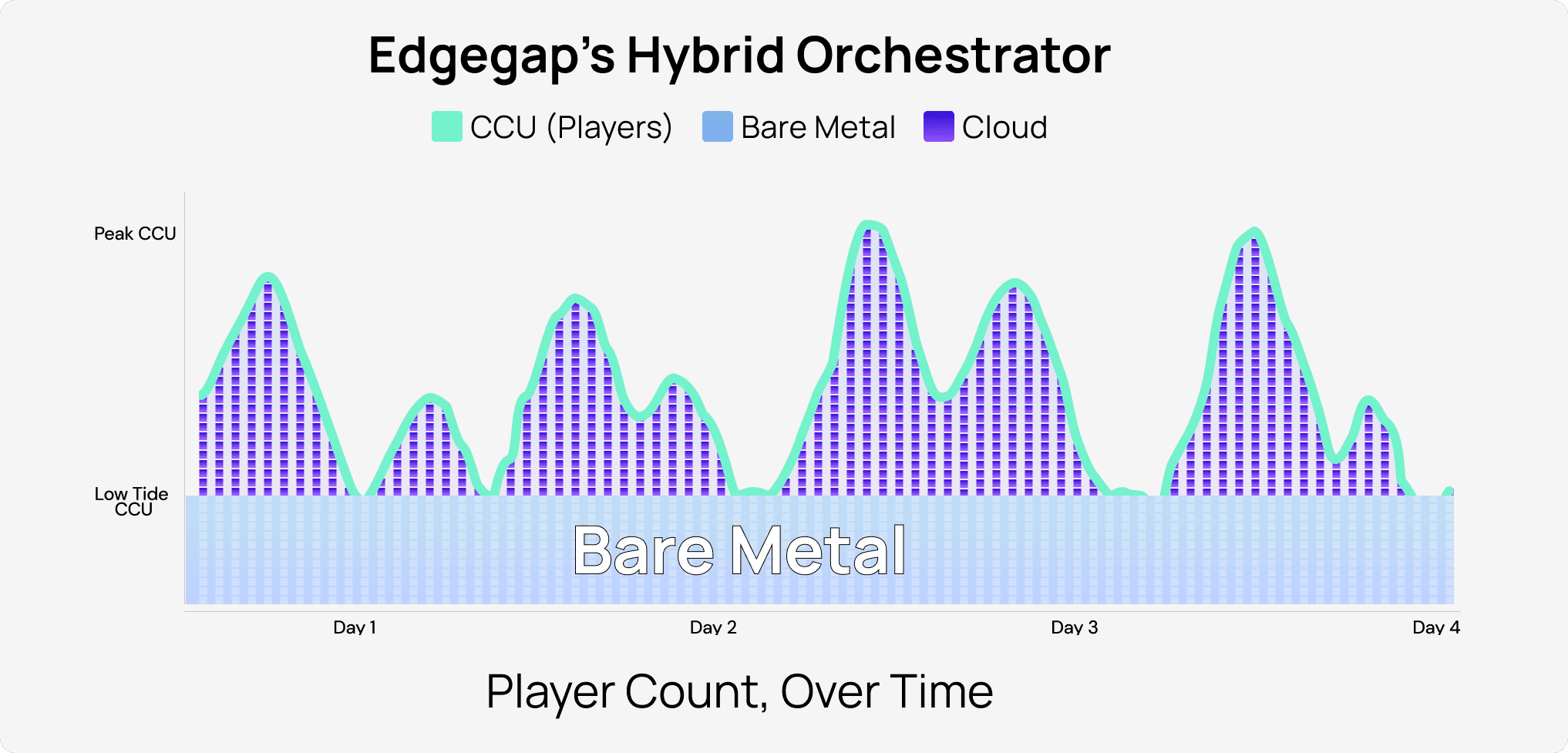
A smart strategy many game studios use is a hybrid approach: run your baseline player load on bare metal to capture the cost savings, then burst to the cloud when you need to handle spikes; like during a major update launch or promotional event. This gives you the best of both worlds: affordable base capacity with cloud burst through hybrid orchestration.
In multiplayer game development, bare metal servers are primarily used to host game server instances that power your player experience. Each server runs the authoritative game state, handles player inputs, manages physics calculations, and synchronizes gameplay across all connected players. Whether you're running a battle royale with 100 players, a competitive shooter, or a massive MMO, these servers are the backbone of your multiplayer experience.
Challenges of using Bare Metal Servers
Now, there are evidently challenges to any networking infrastructure. Bare Metal’s challenges includes:
Capacity Planning: Unlike cloud platforms where you can spin up new servers in minutes (seconds with Edgegap), bare metal requires you to predict your needs months every month and manually estimate your purchase (or months/years in advance to get a commitment discount).
Thus, you need to estimate peak player counts and configure everything before launch day. If your game becomes more popular than expected, you can't just click a button to add capacity; you're stuck waiting for new hardware. This forces you to over-provision and pay for idle capacity "just in case."
Financial Risks. Cloud infrastructure is an operational expense (“OpEx”) you pay only for what you use. Bare metal sometimes requires capital investment or long-term contracts, often locking you into hardware for a year or more.
If your game's player base shrinks or doesn't meet projections, you're still paying for those servers.
Infrastructure becomes your problem: With bare metal, you're responsible for everything. Patching servers, upgrading software, managing load balancing, monitoring performance; it all requires careful coordination to avoid disrupting your players. You need to build a platform team to handle these operations, which means higher headcount and ongoing maintenance costs.
For example, that ongoing DevOps workload is precisely why Combat Waffle’s Ghost of Tabor migrated to Edgegap’s automated orchestration.
For any game development team in a challenging market, these pain points often outweigh the cost savings.
For established studios with consistent player bases, bare metal can unlock significant competitive advantages through lower costs.
The key is understanding where your game's scale and consistency justify the operational investment required to make bare metal work.
Solution: Edgegap’s Private Fleet
Edgegap’s Private Fleets empower game studios to cost-effectively run persistent servers for MMOs and social games without infrastructure management.
Including automated server management, orchestration of bare metal hosting with cloud burst, enterprise-grade reliability and ensuring low-latency performance to players.
In short, it allows game developers to access:
Instant Infrastructure with Custom Specifications: Pick & chose always-on, fully managed servers in your preferred locations worldwide without the red tape; including custom specifications (CPU/memory ratios, clock speed).
Game-Ready Compatibility: Launch faster with native support for automated matchmaking and server browsers features.
Enterprise-Grade Reliability: Monitoring, analytics, and proactive alerts alongside DDoS Protection.
All of this is well, but what people want when they seek bare metal is lower cost.
Edgegap’ss hybrid orchestration helps studios to optimize costs with bare metal & scale seamlessly into Edgegap’s public cloud with 615+ locations worldwide. In their words, it allows you to deploy to your private bare metal servers worldwide to optimize costs with free egress and burst into Edgegap’s public cloud for unplanned traffic spikes.
Or to put it visually, leverage bare metal for stable traffic, and scale to cloud for spikes:
Now, if you want to assess your game and what the ideal bare metal spend would be, make sure to contact us!
Don’t want to talk to us and just want to pick your location? Well, that’s why we’ve built purchasing servers directly in our application, when you can spin up servers in minutes without talking to sales. Neat.
Edgegap’s Server Browser
Now, it’s one thing to set up an architecture, certain game types like MMOs and social games with persistent servers will want to enable players to discover and join these servers.
Edgegap's Server Browser makes it easy and cost-effective to operate persistent multiplayer servers from small-scale games to massive MMOs, with key features including automated session management with latency optimization, built-in game client authentication, server meshing for MMO-scale worlds, 1-click bare metal integration with cloud burst, and enterprise-grade monitoring, analytics and reliability.
Learn more about Edgegap’s Server Browser feature here.
Written by
the Edgegap Team