Competitive VR needs Infrastructure to Match: Breachers Migrates to Edgegap

Written in collaboration with
Triangle Factory
Key Highlights
In a tactical round-based VR shooter, a single desync or missed registration can decide a match. Edgegap's patented server placement deploys each session at the optimal location for all players, delivering the consistent low-latency performance competitive play requires.
Breachers supports cross-play across mobile, PC, and console VR headsets, meaning players on different hardware and different networks need the same experience. Edgegap's 615+ location regionless network and usage-based pricing made that global coverage viable without trade-offs.
Triangle Factory runs Breachers alongside Forefront and Hyper Dash with no dedicated backend team. Edgegap's self-serve portal and direct Slack support kept operations lean and the team focused on the game.
Breachers is one of three Triangle Factory titles running on Edgegap. Read how the studio also migrated Forefront and Hyper Dash, each with its own challenges and solutions.
The Studio
Triangle Factory is a Belgium-based VR game studio specializing in competitive and social multiplayer experiences. They are best known for Breachers, a tactical 5v5 VR shooter, and Hyper Dash, a free-to-play team-based arena shooter. Both have built dedicated, passionate communities in the VR space. Forefront, their most recent release, is a 32-player VR warfare experience that launched its full "1.0" version in April 2026 taking the VR world by storm.
Breachers is Triangle Factory's flagship competitive title. Two teams of five face off in close-quarters tactical combat: enforcers breach and disarm, revolters defend and eliminate. Every round is a fresh tactical problem. Players plan assaults, customize loadouts, master gadgets ranging from drones and cloaking devices to breaching foam and tripmines, and execute under pressure. The game supports cross-play across Quest, Pico, PCVR and PSVR2, bringing together players across hardware platforms in the same sessions. Regular content updates have kept the community engaged and growing since launch.
The Challenge
Tactical shooters are built on a single promise: what you do is what happens. Players invest hundreds of hours mastering angles, timing, and coordination. When the infrastructure breaks that promise, even briefly, the competitive experience collapses.
In a 32-player VR warfare game, a moment of desync is absorbed by the chaos of the match. In a 5v5 round-based tactical game, it ends the round. One unregistered shot, one fraction-of-a-second delay, one out-of-sync gadget throw. These aren't minor inconveniences. They are, from the player's perspective, the game failing them at the worst possible moment. These issues, often grouped under "latency" is the number one reason players churn out of multiplayer. That is doubly true when precision is core to the gameplay experience. Breachers doesn't sell chaos. It sells the satisfaction of a plan executed perfectly. That promise only holds if the infrastructure behind it does too.
VR adds another layer of demand. The immersive nature of the medium means players feel performance issues faster and more viscerally than in flat games. Frame drops and latency spikes that might go unnoticed on a monitor are disorienting in a headset. For a game built around the physical sensation of breaching a doorway or rappelling through a window, the quality of that experience is inseparable from the quality of the infrastructure behind it.
A player base spread across headset types and platforms compounds the challenge. Triangle Factory's players are geographically distributed and on different hardware. Every session has to feel identical regardless of which headset a player is using or where they are connecting from.
Finally, Triangle Factory operates with a lean engineering team. Breachers is a live service with an active competitive community. Managing its infrastructure shouldn't require resource away from development of the game.
The Solution
Breachers migrated to Edgegap weeks after Forefront's successful migration. The speed of that second move was no accident. Triangle Factory had already validated Edgegap's performance through Forefront's 36-hour test and full Early Access deployment. Moving Breachers over was straightforward, both because the integration process was familiar and because the team already trusted what the platform could deliver.
Server placement built for precision
Edgegap's orchestration uses a patented decision-making system to deploy each game server at the optimal location for all players in a match. For Breachers, where sessions mix players across headset types and geographies, that means every player in a session gets the best available connection, not just the players closest to a fixed regional server.
The result is consistent, low-latency performance across the board. As Pieter Vantorre, CTO at Triangle Factory, put it:
"What mattered most to us was global availability and low latency for our players."
That is the standard Breachers' community expects. Edgegap's regionless edge network, spanning 615+ locations worldwide at a single universal price, is what makes meeting it viable at Triangle Factory's scale.
The community confirmed the performance immediately
Triangle Factory didn't need to announce the migration. Their players noticed on their own. From the Breachers Discord:
"why are the new breachers servers so flipping good" – Discord user

"these new servers are fire bro keep it up" – another Discord user
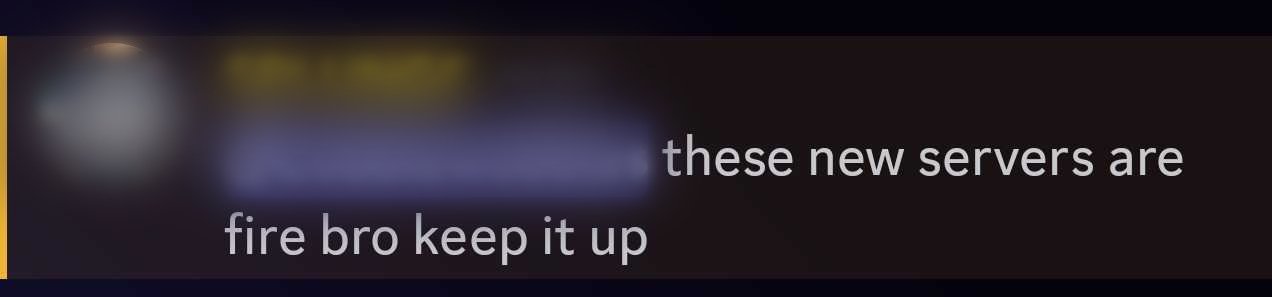
Organic feedback from a competitive community is the hardest kind to earn. These players care deeply about server quality. They felt the difference.
Self-serve operations and direct support
Running a live competitive game means infrastructure decisions happen in real time. Triangle Factory needed to be able to act independently, without waiting on a vendor to configure or deploy. Edgegap's self-serve portal gave them that control. And when questions came up, a shared Slack channel with the Edgegap team provided fast, direct answers.
As Pieter described:
"The customer support was excellent, and being able to integrate Edgegap directly into our internal communication channels made the whole process feel seamless."
For a small team managing multiple live titles, that combination of self-sufficiency and responsive support is not a nice-to-have. It is what keeps operations from becoming a bottleneck.
Transparent, usage-based pricing
Breachers is a live service. Player counts shift, sessions vary, and infrastructure costs need to follow actual usage rather than reserved capacity. Edgegap's single universal price, charged on real compute usage, meant Triangle Factory always knew what they were paying for.
Conclusion
After Forefront proved Edgegap's performance through a deliberate 36-hour validation, bringing Breachers onto the platform was not a question of whether. It was a question of when.
For Triangle Factory, the answer was: weeks later. The integration was familiar, the performance was confirmed, and the trust was already there. As Pieter Vantorre summed up the decision:
"For us, it came down to migrating to a mature player with a proven track record."
Breachers' competitive community has high standards. The Discord messages said everything that needed to be said.