On Demand, On Budget: Triangle Factory Brings Hyper Dash to Edgegap
Written in collaboration with
Triangle Factory
Key Highlights
Hyper Dash is free to play. Every server cost is overhead. Edgegap's just-in-time, usage-based pricing means Triangle Factory only pays for compute when players are actually in a session, with no idle capacity charges between peaks.
For F2P titles, costs that don't track directly to usage make planning difficult and erode the revenue-to-cost ratio that determines whether a game is viable to operate. Edgegap's single universal price with no hidden fees gave Triangle Factory full visibility over their costs at any player volume.
By the time Hyper Dash moved to Edgegap, Triangle Factory had a well-worn integration process and full trust in the platform from Forefront and Breachers. The move was fast, familiar, and friction-free.
Hyper Dash is one of three Triangle Factory titles running on Edgegap. Read how the studio also migrated Forefront and Breachers, each with its own challenges and solutions.
The Studio
Triangle Factory is a Belgium-based VR game studio specializing in competitive and social multiplayer experiences. They are best known for Breachers, a tactical 5v5 VR shooter, and Hyper Dash, a free-to-play team-based arena shooter. Both have built dedicated, passionate communities in the VR space. Forefront, their most recent release, is a 32-player VR warfare experience that launched its full 1.0 version in April 2026.
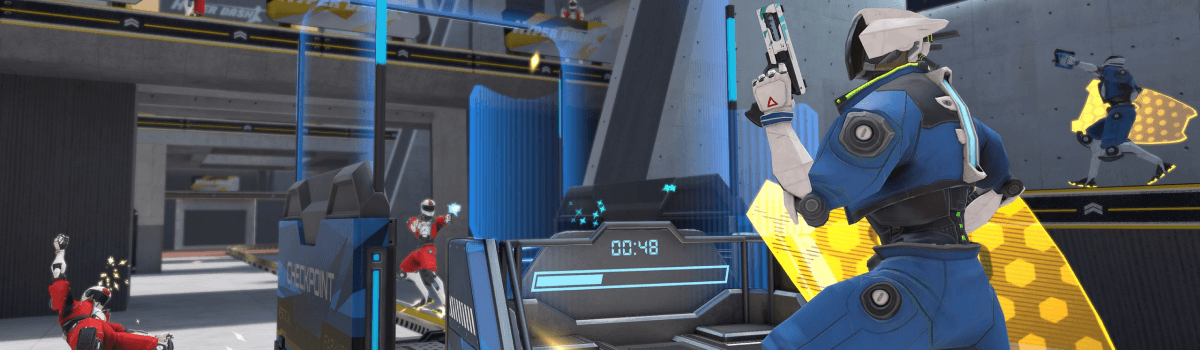
Hyper Dash is Triangle Factory's free-to-play VR shooter built around movement. Players dash, sprint, and rail grind through fast-paced arenas across seven game modes: Payload, Domination, Control Point, Team Deathmatch, Capture the Flag, Elimination, and Ball. Mutators let players customize matches with modifiers like Instagib or Low Gravity, and a server browser surfaces community-created sessions. The game is designed for players who want to jump straight into action, with compact maps, fast respawns, and a gameplay loop that rewards agility and coordination.
Hyper Dash was the third and final Triangle Factory title to migrate to Edgegap, following Forefront and Breachers. By that point, the team had a well-practiced integration process and a platform they already trusted in production across two live games. The migration was the fastest of the three.
The Challenge
Free-to-play games operate on a demanding equation: average revenue per daily active user must exceed the cost per daily active user to be profitable. Revenue comes from optional in-game purchases, not guaranteed upfront payments. That means every cost line, including infrastructure, has a direct relationship with whether the game makes financial sense to operate.
The central problem of any F2P games is costs that don't track directly to usage.
When infrastructure charges regardless of whether players are in active sessions, the cost-to-revenue ratio becomes difficult to manage and harder to forecast. A spike in costs that doesn't correspond to a spike in player activity is money spent with no return.
On the game server orchestration side, fixed and wasted infrastructure costs are the most visible form of this problem. Reserved capacity that sits idle between play sessions, servers that remain running when no matches are active, and regional pricing complexity that obscures the true cost per player all contribute to overhead that doesn't move with the game. For a title where every operational dollar needs to justify itself against player revenue, that kind of structural inefficiency compounds quickly.
Triangle Factory runs Hyper Dash, like all their titles, with a lean engineering team. The infrastructure needed to be something the team could manage without significant overhead, and something whose costs they could read clearly at any point in time.
The Solution
Just-in-time, on-demand deployment
The core unlock for Hyper Dash was Edgegap's on-demand game server orchestration model.
Servers spin up when players need them and shut down when they don't. Triangle Factory pays for compute only when it is actively being used. No standing instances, no idle capacity charges, no paying for empty servers between sessions.
For a F2P title, this is the difference between infrastructure that erodes margin and infrastructure that moves in sync with the game's revenue. When player activity is high, servers scale to meet it. When it's quiet, costs follow.
A single price, tied to real usage
Edgegap's pricing model operates at a single universal price across all 615+ locations on-demand, charged on actual compute usage. No regional pricing tiers, no hidden fees, no minimum commitments. Costs track directly to player activity, making forecasting straightforward and eliminating the billing surprises that come with traditional capacity-based models. That single price also extends to all 615+ locations worldwide, ensuring players everywhere get the responsive experience that Hyper Dash's fast-paced movement demands.
As Pieter Vantorre, CTO at Triangle Factory, put it:
"Getting rid of untransparent billing of other vendors. Edgegap's pricing model is simple and transparent."
That clarity matters operationally. When costs are legible, decisions are easier. Triangle Factory could look at their infrastructure spend at any point and understand exactly what they were paying for and why.
Self-serve operations, direct support
Triangle Factory managed the Hyper Dash migration and ongoing operations through Edgegap's self-serve portal, with a shared Slack channel available for direct, fast answers when needed. For a team running three live titles without a backend department, that combination of independence and accessible support kept infrastructure from becoming a time sink.
The third migration, and the fastest
Having moved Forefront and Breachers to Edgegap in the months prior, the Hyper Dash migration required no new learning. The integration process was familiar, the platform was trusted, and the team moved quickly. There is a compounding benefit to consolidating a studio's full portfolio onto a single infrastructure platform: by the third migration, it is close to routine.
Conclusion
Hyper Dash is where Edgegap's cost model had the most direct impact. On-demand infrastructure that charges only for real usage, paired with transparent and predictable pricing, is what makes a free-to-play game financially sustainable to operate over time.
With all three Triangle Factory titles now running on Edgegap, the studio has a consistent infrastructure layer across their entire portfolio. One platform, one pricing model, one support channel. As Pieter Vantorre, CTO at Triangle Factory, sums it up:
"Good customer support. Simple to use and polished interface. A handy self-serve portal. No need to wait for the vendor to finish setting things up."
Three games. One platform. A clear measure of what Edgegap's orchestration makes possible.