Matchmaking Deep Dive: Regional Matchmaking and Server Region Selection
Region selection is a player complaint, not a feature request: When players ask to pick their server region, they are reporting a latency problem they cannot see or control. The feature they request is one possible answer, and on a smaller playerbase it trades bad matches for unfilled ones.
Latency-based grouping solves the issue that region locking attempts to mitigate: Regions are administrative boundaries. Latency is measured. Grouping players by measured ping keeps distant players out of the same lobby without partitioning the queue by geography.
Relaxing rules over time is the lever most matchmakers underuse: Activision's published research loosens skill constraints faster than connection constraints as queue time grows. The same graduated approach applies to any pooling rule.
Queue time is negotiable when the tradeoff is visible: Players in several communities volunteer to wait longer for better connection or a more filled match. The waiting is not what frustrates them. Not knowing what it buys them is.
Transparency and agency shorten the feedback loop: A visible ping figure and an opt-in to wait for a closer server turn vague blame into something a player can act on, at the cost of exposing numbers you may not want exposed.
The request shows up in nearly every multiplayer community eventually, and the specific wording barely changes. A Battlefield 6 player asks EA to "Let us pick our server region, don't force high ping servers on us", explaining they sit in the midwest, get 50-60ms to the East Coast official server, and land on what they suspect are West Coast servers at around 100ms. A Rocket League player asks whether it is possible to disable expanded region matchmaking, reporting opponents at 200+ ping. A PUBG player hunts for the server select button that used to sit at the bottom of the lobby and disappeared in an update.
None of these communities is wrong, and the games involved are not doing anything unusual. That is what makes the request worth examining rather than simply answering. Activision's second matchmaking white paper (2024) remains the most detailed public account of how a large studio weighs connection quality against other match criteria. The rest of this analysis comes from running Edgegap's matchmaker across live titles at a range of population sizes, where these tradeoffs stop being theoretical.
What follows is what players are reporting when they ask for region selection, the mechanisms available to address it, and what each one costs.
What Players Are Reporting
The complaint, in its most common form, is
Matches are inconsistent. Some are fine. Some are unplayable.
The player cannot predict which they are about to get, and nothing in the game explains the difference.
What that actually describes is a connection quality problem with no visibility and no input.
Which opens up the response. If the report is "my ping is inconsistent," then a region picker is one of several mechanisms that could address it, and it happens to carry the largest side effects. Read literally, the request produces a feature that answers the symptom while the cause, which is how the matchmaker groups players in the first place, goes untouched.
What Dividing the Queue Costs
Region selection does not create players. It divides the ones already in the queue.
A game with a healthy population absorbs that easily, which is why the feature is standard in titles with hundreds of thousands of concurrent users. A game with a few thousand does not. Split across regions, then across skill brackets, party sizes and playlists, each pool can shrink to a few dozen people at off-peak hours. The matchmaker's remaining option is to wait. The player's remaining option is to stop waiting. An Apex Legends player shows the far end of this, reporting 50-minute queues and finding the same wait in every region they switched to.
Players sometimes work out the mechanism themselves. In one smaller game's feedback thread, the top reply to a region selection request argued the studio would not ship it because it "would make the matchmaking times too high" and expose the size of the playerbase.
Region is only one axis of that division. Playlists are the axis most developers already know about and still underweight, because mode count gets decided in a room where nobody is looking at pool depth. Three actions follow, in descending order of difficulty:
Grow the population per region. A user acquisition problem rather than an engineering one, and the only option that makes the others unnecessary.
Consolidate modes. Communicate clearly to players that game modes selection is a priority, but not a mandatory rule versus ensuring a player joins a match.
Add a queue fallback. Offer a player who has waited too long in one mode a match in an adjacent mode, rather than more waiting.
Nobody enjoys cutting modes, and the resistance is legitimate: variety is part of why people keep playing. The fallback keeps the variety but needs care, since a player dropped into a mode they did not pick reads it as a bug unless the offer was explicit. And region selection stays population-dependent either way. It works when each region can sustain its own queue, and degrades quickly when one cannot.
Distance Is the Constraint, Not Regions
Regions are administrative. Network distance is physical, and it determines whether a match can be served fairly at all. The effect is easy enough to confirm independently: a distributed measurement tool like Globalping will show you real latency from probes around the world to any host you pick, which is the raw material a balance point is computed from.
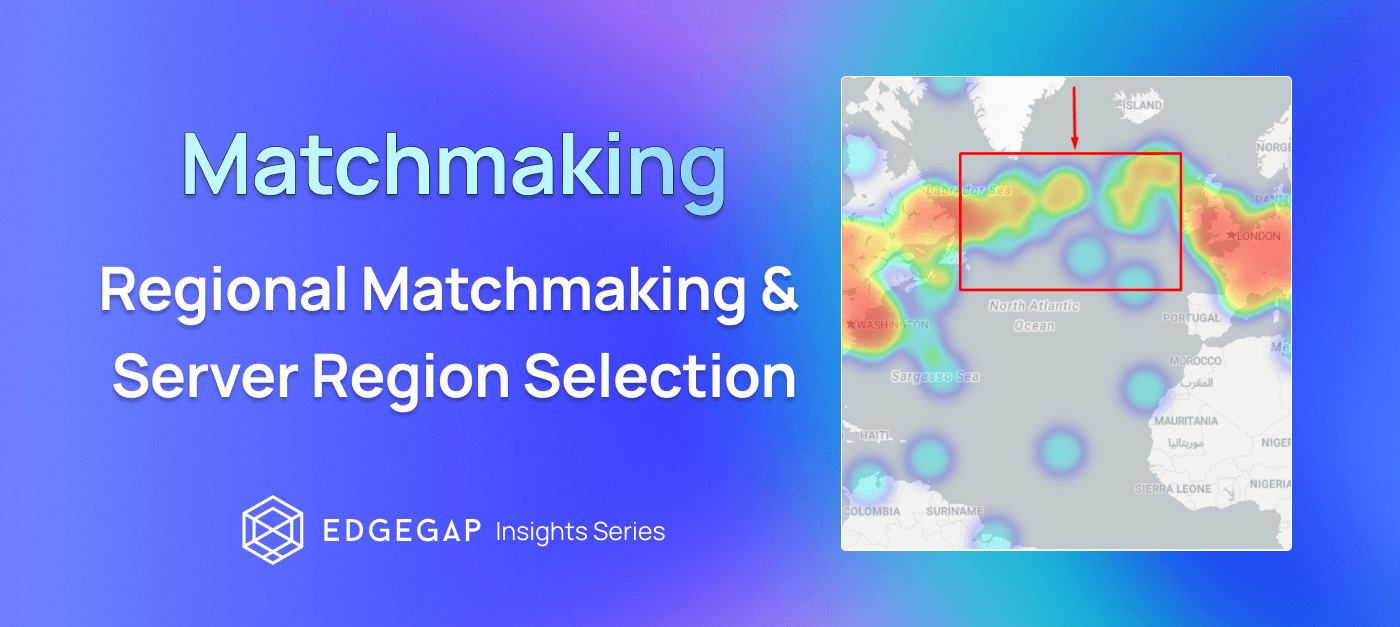
Edgegap measures each player's latency to a network of beacons at matchmaking time, then computes a balance point: the approximate location with equal network proximity to every player in a proposed match. It answers one question, which is whether a server location exists that treats this particular group equally.
The heatmap below plots those balance points across a set of live deployments. The clusters over the central United States and the UK are unremarkable, because real capacity sits nearby. The highlighted cluster is the interesting one. Those are matches whose fairest possible server location is the North Atlantic.

No facility exists there obviously, so each of those matches gets hosted somewhere that favors one side. In the case above, it's most often North American East Coast or United Kingdom.
Nothing about this is specific to oceans. A lobby spanning two ends of a large country produces the same result at a smaller scale. Whenever the group is too dispersed, someone plays at a disadvantage unrelated to their aim, and fairness degrades measurably. Edgegap's 1v1 testing found a 28% fairness improvement when matches were formed and hosted with latency parity in mind.
Two mechanisms address this without a region dropdown.
Group players by measured latency rather than declared region, relaxing that constraint as needed, which is how Edgegap's matchmaker handles it.
Or deploy below maximum fill rate, starting a 6v6 as a 4v4 instead of pulling a seventh player in from another continent. The first costs queue complexity and some longer waits at the margins. The second costs match size, which reads as a downgrade on paper and often plays better than the alternative. How often either is necessary depends on how much capacity sits near your players, which is the practical case for more locations rather than more regions.
Rules That Relax Over Time
Most matchmaking constraints are set once and applied uniformly. Treating them as fixed thresholds is what produces the strict-versus-loose argument, and that argument has no winner, because both settings are wrong at different hours of the day.
Activision's white paper describes something more granular. The system tracks delta ping, the difference between a player's best available connection and their connection to other data centers, and applies a backoff mechanism as queue time grows. Constraints loosen the longer someone waits. Skill constraints loosen faster than connection constraints, reflecting the paper's position that connection quality outweighs skill (Edgegap's breakdown of those findings, and the mechanics of applying latency rules).
The generalizable part is not the thresholds. It is that a rule with a relaxation curve serves a variable population better than a rule with a single value, and this holds for any pooling logic, latency or otherwise.
What it costs is tuning. A curve has to be fitted to a real population and revisited as that population shifts, and players queueing at quiet hours get looser matches by design. Better to decide that deliberately than discover it.
Relaxation also compounds with latency-based grouping in a way region locking cannot reproduce. Because the constraint being loosened is measured ping rather than a region label, widening it pulls in whoever is actually close enough, not whoever happens to sit inside the same administrative box. A player queueing in Asia at a quiet hour can be matched against a player in India if both fall inside the same latency band. Under a strict region lock, that match does not exist. The pool is drawn by the map rather than by the network, so an off-hours queue has nowhere to widen into.
Queue Time Is Negotiable When the Tradeoff Is Visible
Queue time is the metric studios defend hardest, and the data supports defending it. Edgegap's latency research attributes 34% of player churn to time spent waiting in queue.
The threads complicate that usefully. The Battlefield poster offers to accept longer matchmaking for a better connection. A player in a much smaller game's thread put a number on it: queue times "under 2 minutes pretty often recently," and an explicit willingness to accept five or more if the match were playable.
Neither is complaining about waiting. Both are complaining about waiting and then getting a match they cannot play. Wait time appears tolerable when players understand what it purchases, and intolerable when it appears to purchase nothing.
That points to one low-cost action, which is making the exchange legible at the point of queueing. A queue that says it is searching for a low-latency match, or offers to keep looking for a closer server, asks the player to opt into the tradeoff instead of absorbing it silently. The cost is candor about your own numbers, plus the risk that some players decline and leave. The 34% figure does not disappear because forum posters said they would wait.
Transparency and Agency
Two of the requests in these threads have nothing to do with servers. Players want to see their ping, and they want a say in when they accept a bad one.
On one smaller game's public feature request board, the first entry filed, in June 2026, asks for player and server latency on the scoreboard along with the connected server's location. Forum commenters make the same request, one noting they do not understand the decision to hide the number.
The mechanism behind that frustration is simple. Without a latency readout, a player cannot separate a distant server assignment from their own connection or from a netcode issue. Every bad match becomes unattributable, and unattributable bad matches tend to get attributed to the developer. Showing the number improves nobody's connection. It changes what the player does with a bad one, which is diagnose rather than accuse.
Two shipped examples are worth studying. Counter-Strike 2 exposes a "Max Acceptable Matchmaking Ping" setting, which hands the latency ceiling to the player along with the queue time that comes with it. Street Fighter 6 goes a step further into pre-match context, displaying whether an opponent is on Wi-Fi or wired before a match starts, which tells a player something about connection stability that raw ping does not capture. Rivals of Aether 2 is another community that responded well to being told the truth about its online conditions (breakdown of its online experience).

The cost is exposure.
Published ping figures invite scrutiny of infrastructure decisions, and a bad number gets screenshotted and complained about on Reddit. Keeping the number hidden avoids that... but it tends to shift rather than remove the conversation, since players still arrive with the same complaint and no data to attach it to.
Where That Leaves the Request
The players thread are not wrong about the experience they describe. Across several games and population sizes, players are landing in matches their connection cannot support with no visibility into why.
Region selection is one response, and the one that most directly shrinks the pool available to match with, which is why it ships in large titles and struggles in small ones.
Activision's conclusion, after testing at a scale most studios will never reach, was that players tolerate a mismatch in skill more readily than a bad connection. What the community threads add is that they appear to tolerate a longer wait too, provided somebody tells them what it is for.
—
This article is based on and cites public community threads on the EA Forums (Battlefield 6 General Discussion) and the Steam Community discussion boards for Rocket League, PUBG: BATTLEGROUNDS and Apex Legends, alongside the Call of Duty Matchmaking Series white paper published by Activision Research in 2024 (research.activision.com). All rights in the original content are owned by their respective owners.
Written by
Jakub Motyl, Product at Edgegap