Dedicated Server
A dedicated game server is a server process that runs the match independently of any player's machine, with full authority over game state. Every client connects to it, and it decides what actually happened. It is the standard for competitive multiplayer because no player's hardware can influence the outcome.
,
What Is the Difference Between a Dedicated Server and a Listen Server?
Every multiplayer match needs one copy of the game that everyone else agrees with. The question is where that copy runs.
On a listen server, it runs inside one player's game. That player hosts and plays at the same time, while everyone else connects to them. On a dedicated server, it runs as a separate process that nobody plays on. Every player connects to it on equal terms.
Two more words travel with the term, and each names a different property:
Authoritative describes who decides. An authoritative server is the final word on what happened, and clients only send requests. A listen server is also authoritative, which is the problem: the authority belongs to one of the players.
Headless describes how it is built. A headless server is the game compiled without rendering, audio or local input, because nobody is looking at it.
In practice the three usually describe the same server: a headless build, running dedicated, holding authority. Being dedicated does not make a server authoritative on its own, though. A dedicated server that trusts what clients report about themselves can be fooled like any other.

How Is a Dedicated Server Built?
The server comes from the same project as the client, built for a different target, usually Linux, and usually packaged as a container image so any host can start it the same way. Each engine gets there differently, and each can be scripted so a continuous integration (CI) pipeline produces a new server image on every commit:
Unity has a Dedicated Server build target that strips rendering and client-only assets. It can be built from the command line in batch mode, which is what CI pipelines run.
Unreal builds the server from a separate server target. That has traditionally meant compiling the engine from source, a long first build. Epic's published container images now let a pipeline build server targets without maintaining its own engine build.
Godot 4 can export a project as a dedicated server, which strips visual resources, and runs it with the
--headlessflag.Web games without an engine, for example a Three.js client, have no server build target at all. Three.js only draws the scene. The server is a separate program, often Node.js sharing the game logic written in JavaScript or TypeScript, and it talks to browsers over WebSockets or WebRTC, since browsers cannot open raw UDP connections.
Edgegap offers automated build tools for each major engine, including Godot, Unity and Unreal.
Whichever the engine, code written on the assumption that a local player exists, such as camera logic, UI or input handling, has to be kept out of the server build. Projects that start on a listen server usually find this late.
When Does a Dedicated Server Run, and Who Runs It?
Two decisions shape a server's lifetime.
Per match or persistent. In session-based games, a server starts when the matchmaker forms a match and stops when the match ends. Nothing runs between matches, so nothing is paid for between them, but players wait while a new server becomes ready. Persistent worlds, such as survival servers or MMO shards, keep one process running whether anyone is connected or not. The world is always there, and so is the bill.
Studio or players. Palworld, Valheim and ARK ship their server builds to players, which is why most searches for this term come from players setting one up. Player hosting moves the cost to the community and can keep a game playable after official support ends.
It also changes who holds authority. A server running on a player's machine answers to that player, who can read its memory, edit its files and change its rules. The trust model becomes peer-to-peer's, with the same exposure to cheating and tampering. Many games run both: official servers for ranked and matchmade play, community servers where a trusted host is acceptable.
How Much Does a Dedicated Server Have to Do?
"Dedicated server" covers a wide range of jobs. Where a game sits on that range is its scope, and scope is the main thing hosting cost follows.
Relay-style. The server forwards messages between players and checks a handful of rules, such as who may join and whether a reported result is plausible. Little CPU, little memory.
Result referee. Clients simulate, and the server validates outcomes: scores, inventory changes, purchases. Enough to stop the cheats that rely on a client reporting its own success.
Multi-room. One process hosts many small sessions side by side, common for casual, card and turn-based games, so the cost of the process is shared across several matches.
Full simulation. The server runs the whole game loop for every player, from 2 to 100 or more: physics, movement, hit detection, at a fixed tick rate. This is what competitive shooters need and what most people picture when they hear the term.
Each step up buys more protection and more consistency, and costs more CPU per player. A card game hosted like a battle royale overpays. A shooter hosted like a card game cannot stop the cheats that matter to it.


A word from our sponsor (ourselves!)
Warm pools make allocation fast because you pay for servers that sit idle. Edgegap provisions a fresh game server in a median of 2 seconds from cold start, measured to container ready before your engine starts, so a server exists only once a match needs one.
What Does Running Dedicated Servers Cost?
Cost follows scope. A server's bill is the share of a machine it occupies, for as long as it occupies it, and four things decide that share:
Density. How many instances fit on one host. Scope, player count and tick rate set the CPU each one needs, and doubling the tick rate roughly doubles it.
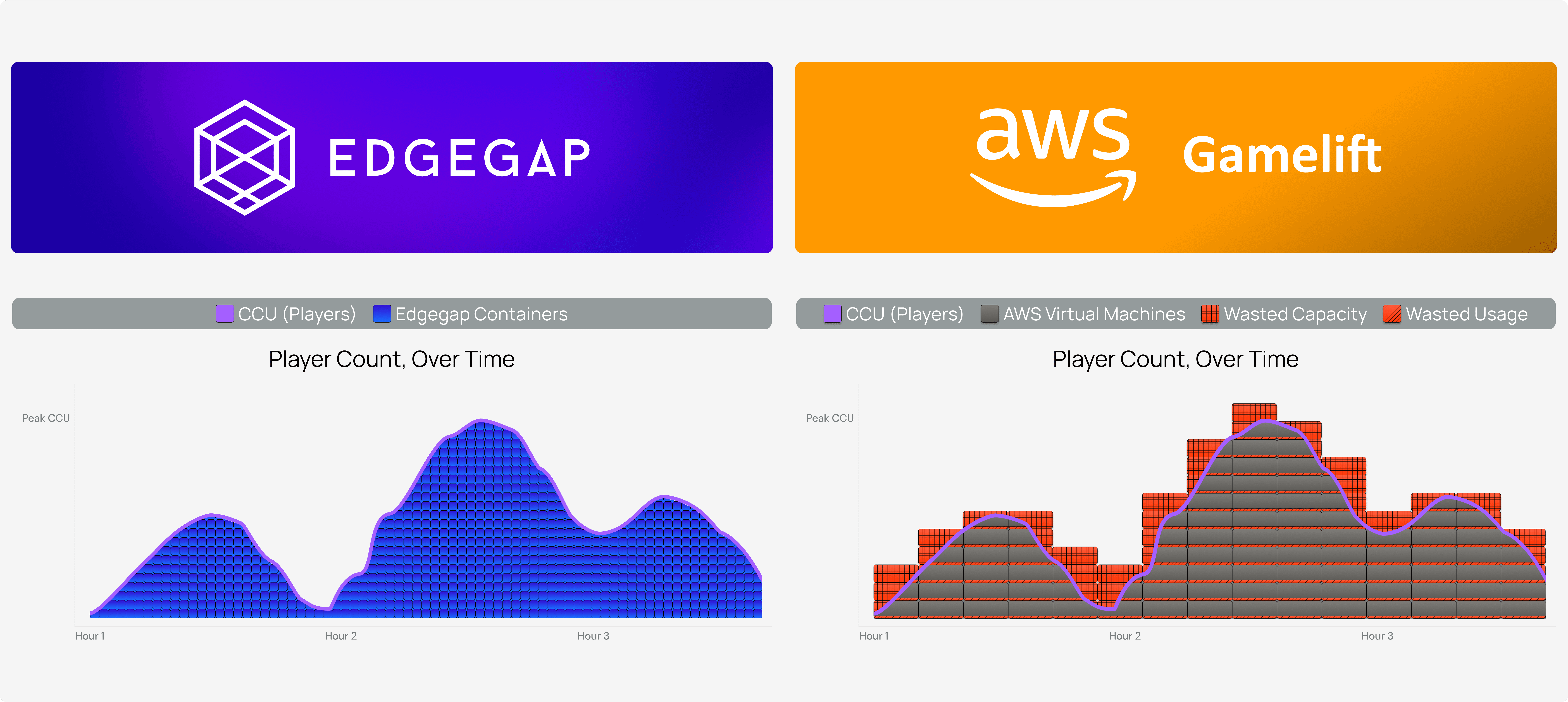
Idle capacity. Servers provisioned for peak that sit empty off-peak, and seats inside running servers that never fill. Both are paid for.
Egress. Every state update leaving the server is billed transfer, multiplied by every connected player.
GPU. A headless server rarely needs one today. Games that move AI inference to the server, for NPC behavior or voice, may, and GPU capacity is typically priced far above CPU, which changes the cost per match more than anything else on this list.
The alternative is peer-to-peer, which costs nothing to host and is paid for elsewhere: the host plays with an advantage, the match depends on one player's connection, and every client is trusted, which leaves the door open to hackers and cheaters.
How much idle time you carry depends on the billing model. Reserved machines are paid for whether they are full or empty, and are cheapest per core when kept busy. On-demand capacity is paid for only while it runs: Edgegap's Edge Cloud bills $0.00115 per vCPU per minute (platform data, last updated 30 September 2026). Games with a steady population usually lean on the first, games with sharp peaks on the second.
Edgegap's Take (just our opinion, take it with a grain of salt!)
Size the Referee Before You Price It
The first hosting question most teams ask is which provider. The one that moves the economics more is how big the server needs to be.
A competitive game needs an involved referee: a full simulation, a tick rate players will judge it by, and a server per match. A casual game can often run many rooms in one smaller process and validate only what a cheater would want to fake. Both are dedicated servers. Their cost per player can sit far apart.
So before pricing anything, list what the server must decide that no client can be trusted with. That list is the server's scope. Keep it as short as your game allows, and no shorter.
,