Server Regions
Server regions are the geographic areas where your game servers can run. They set the floor on every player's latency, because no player can be closer to a server than the nearest region allows. The number of regions, and how they are spread, matters more than any per-server optimization.
Also called
regions
,
Where Do Server Regions Fit in Matchmaking?
A server region starts as a cloud provider's term: a group of data centers in one geographic area. Games put their own labels on top, such as NA-East or EU-West, and in region-based matchmaking that label is the first decision in a player's session.
The player gets a region, by choosing one, by IP address, or by measured ping.
The player queues in it, with everyone else assigned there.
A match forms from that queue, by skill, mode and party size.
A server starts in the region, often from capacity reserved there in advance.
Only measured ping in step 1 reflects the route a player's traffic actually takes. A region is administrative, a line on a map; latency is physical. The matchmaker then works inside that boundary; measuring ping against ping beacons draws it closer to the network.
In Practices - Insights from Edgegap's Blog
Article's key insights
Region selection is a player complaint, not a feature request: When players ask to pick their server region, they are reporting a latency problem they cannot see or control. The feature they request is one possible answer, and on a smaller playerbase it trades bad matches for unfilled ones.
Latency-based grouping solves the issue that region locking attempts to mitigate: Regions are administrative boundaries. Latency is measured. Grouping players by measured ping keeps distant players out of the same lobby without partitioning the queue by geography.
Relaxing rules over time is the lever most matchmakers underuse: Activision's published research loosens skill constraints faster than connection constraints as queue time grows. The same graduated approach applies to any pooling rule.
Queue time is negotiable when the tradeoff is visible: Players in several communities volunteer to wait longer for better connection or a more filled match. The waiting is not what frustrates them. Not knowing what it buys them is.
Transparency and agency shorten the feedback loop: A visible ping figure and an opt-in to wait for a closer server turn vague blame into something a player can act on, at the cost of exposing numbers you may not want exposed.
What Does Splitting Players by Region Cost?
Every region divides two things.
The queue. Each region is its own pool of players. A region that fills easily at its evening peak can thin out at its quietest hour, until skill brackets, modes and party sizes leave a few dozen people: a longer wait or a looser match.
The capacity. Each region needs servers ready for its own peak. Peaks follow local evenings, so a fleet sized for each region's busiest hour sits partly idle through that region's night.
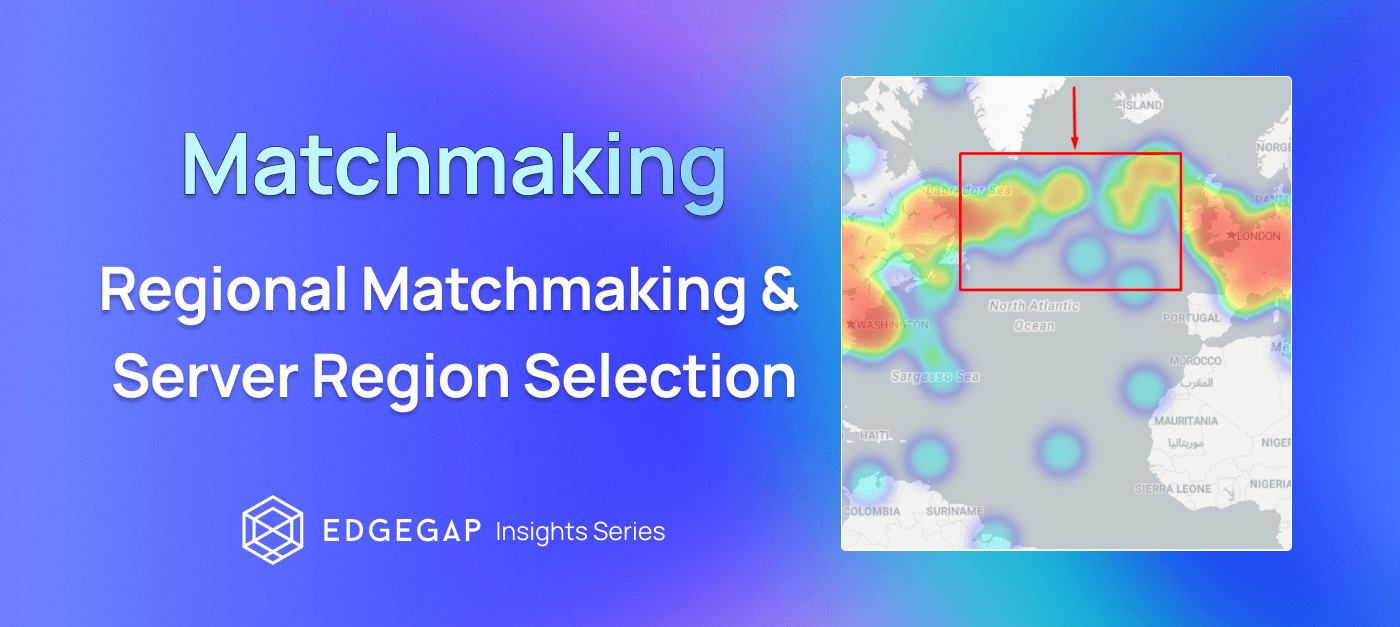
Players between regions pay the most. A player in the US Midwest, or a lobby split across the Atlantic, gets the farther server every match, because the fairest location for that group sits between two regions, sometimes in the middle of an ocean.
Matchmakers soften this with rules that relax over time, widening the search by measured latency the longer a player waits. That narrows the gap. It doesn't remove the boundary.
Can Servers Be Placed by City Instead of by Region?
Yes, when the orchestrator chooses a location for each match rather than for each player. The matchmaker forms a group, and the orchestrator starts its server where those players get the lowest and most even ping. The region stops being a queue boundary: players can be grouped by measured latency, and the server follows the group (see game server orchestration).
On Edge Cloud, Edgegap's orchestrator works this way. Placement uses the players' IP addresses or coordinates and starts the server on demand at the location best suited to them where capacity is available. When that location is full, the next best one is close by, often only a few kilometres away, so the match stays fair and plays well. A developer can also target a city directly by its coordinates.
Every server knows where it landed: Edgegap passes it the city, country and coordinates at start (documentation). A game can show players their server's location, and logs can tie every match to its city.
When Is a Fixed Region the Right Choice?
Often. Per-match placement suits matches that end. Some workloads are better served by a fixed home:
Persistent worlds stay up for weeks and need a location that stays put.
Steady load, the baseline of matches running at every hour, costs less on reserved hosts.
High-egress servers benefit from hosts with egress included.
Data rules can require player data to stay within a country or region.
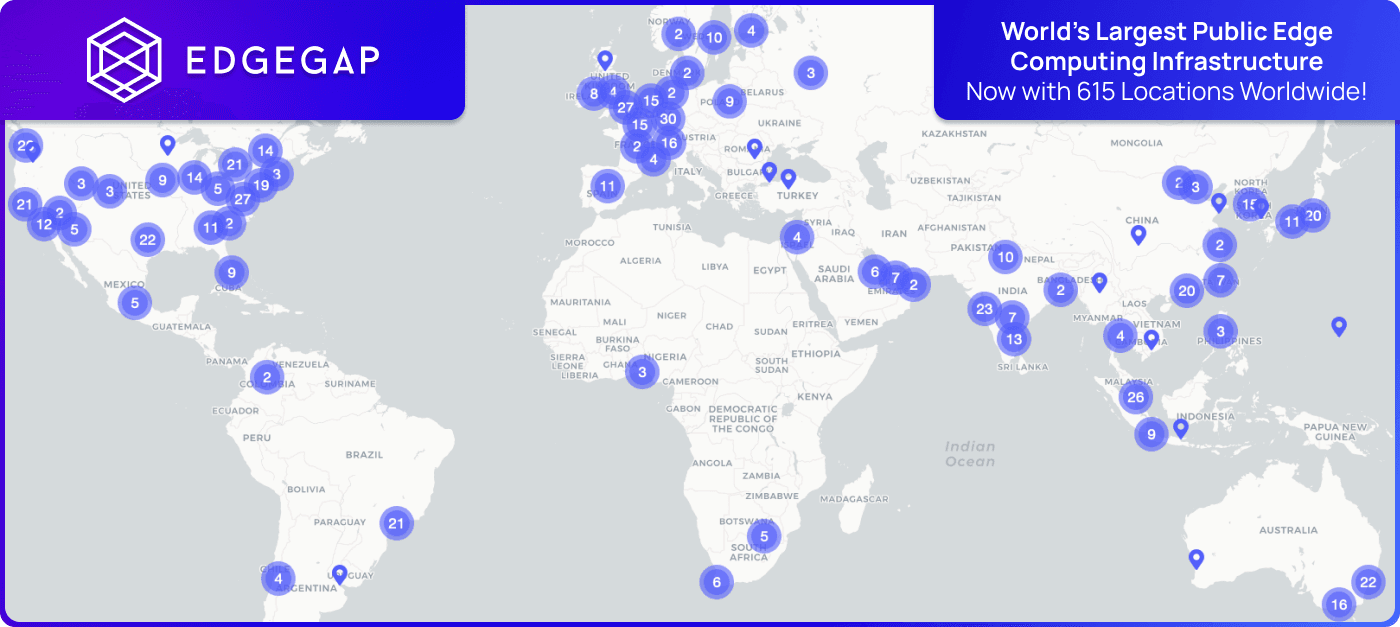
On Edgegap, these and many other cases suit Private Fleet: reserved hosts in 58 locations, egress included, that overflow to Edge Cloud's 615+ locations when they are full (platform data, 18 September 2026). Hybrid orchestration covers how the two work together.


A word from our sponsor (ourselves!)
A region is a guess about where your players will be. Edgegap's Edge Cloud is a distributed, multi-cloud network of 615+ locations across 17+ providers, available on demand. Each server launches at the best available location on the network when the match starts, not at the nearest of a handful of regions.
Edgegap's Take (just our opinion, take it with a grain of salt!)
Regions Were a Capacity Decision
Studios grouped players into regions because capacity had to be bought one metro at a time. A region was where the servers were, so it became where the queue was. Players never asked for regions. They asked for a good ping, and a region picker was the closest thing on offer.
Once capacity is shared across hundreds of locations, a region becomes a choice rather than a constraint. We measured what that choice is worth. In a replay of a AAA publisher's live traffic, deploying each session's dedicated server at the location best suited to its players cut average round-trip time by 58%, from 116 ms to 49 ms, against the publisher's public-cloud setup (case study, 2019).
So keep a region where it pays: where it's cost-effective, costs players little in fairness and latency, and suits the game's design. Whichever mix works best for you, let every other match choose the city closest to its players.
,