Ping Beacon
A ping beacon is a lightweight endpoint that players measure latency against before a match is placed. Clients ping several beacons and report the results, and matchmaking uses them to decide which locations are acceptable or preferred for that group of players, by measured latency rather than map distance alone.
Also called
ping beacons, latency beacon
,
How Does a Ping Beacon Measure Latency Ahead of a Match?
Before a match forms, there is often no game server to measure against: where servers start per match, they start once the players are grouped. A ping beacon fills that gap. It is a small endpoint at a known location whose job is to answer a tiny packet, so a client can time a round trip to roughly where a server could run. The result is a proxy: the server that eventually starts may sit in a nearby data center rather than at the beacon itself.
A measurement is usually a short loop rather than a single ping:
Get the current list of beacons.
Send a few small packets to each beacon and time each reply.
Keep one summary per beacon, such as the median, and note any lost packets, so one spike on a busy Wi-Fi network doesn’t decide the match.
Attach the results to the player’s matchmaking request.
The result is one number per location, measured over the player’s real route to that beacon: a close stand-in for what latency rules in matchmaking need.
In Practices - Insights from Edgegap's Blog
Article's key insights
Region selection is a player complaint, not a feature request: When players ask to pick their server region, they are reporting a latency problem they cannot see or control. The feature they request is one possible answer, and on a smaller playerbase it trades bad matches for unfilled ones.
Latency-based grouping solves the issue that region locking attempts to mitigate: Regions are administrative boundaries. Latency is measured. Grouping players by measured ping keeps distant players out of the same lobby without partitioning the queue by geography.
Relaxing rules over time is the lever most matchmakers underuse: Activision's published research loosens skill constraints faster than connection constraints as queue time grows. The same graduated approach applies to any pooling rule.
Queue time is negotiable when the tradeoff is visible: Players in several communities volunteer to wait longer for better connection or a more filled match. The waiting is not what frustrates them. Not knowing what it buys them is.
Transparency and agency shorten the feedback loop: A visible ping figure and an opt-in to wait for a closer server turn vague blame into something a player can act on, at the cost of exposing numbers you may not want exposed.
How Do Beacon Results Reach the Matchmaker?
The results travel with each player’s matchmaking ticket as data: one latency value per beacon, usually labelled with the beacon’s city or region. A matchmaker can then use them in two ways:
Thresholds: a player is matched only in locations where their latency is under a limit, so a player in Lisbon isn’t sent to a server in Singapore.
Gaps between players: players are grouped when their latencies to the same location are close, so nobody starts the match far behind the others.
Many matchmakers widen these limits the longer a player waits, trading some latency for a shorter queue. Because the numbers come from each player’s own route, they can group players by measured latency rather than by geography alone (see server regions). A server browser can reuse the same measurements to sort servers by the player’s latency to each server’s city, as an approximation, without pinging every listed server.
Once a match is formed, the location where its server starts can be chosen from the same results, or from other data such as the players’ IP addresses.
What Can Make a Beacon Measurement Wrong, and How Does Edgegap Address It?
Three things often skew the numbers:
A stale list: beacons can be added, moved or removed. A client measuring an old list can miss a closer location, or report one that no longer exists.
A changed network: a player who measured at home on Wi-Fi and now queues on mobile data has a different route. Results are most useful when taken close to queue time.
A missing measurement: a beacon that doesn’t answer is unknown, not fast. If a client sends 0 ms instead, a latency rule can read it as the best possible result. Browser builds are a common case: they can’t send raw UDP, TCP or ICMP packets, only browser protocols such as WebSocket or WebRTC, so they can’t measure against beacons that answer only raw packets.
On Edgegap, clients get the beacon list through the matchmaker, or a game backend fetches it from the /locations/beacons API, which is limited to 40 requests a second per organization, so the docs suggest the backend caches it. For matchmaker clients, beacons are “rescaled in real time”, so the docs recommend reloading the list before each matchmaking round, and measuring with ICMP, UDP or TCP ping “is not rate limited” (Edgegap docs). In the matchmaker, beacon results can enable or disable regions and hubs by threshold; the docs’ examples are under 200 ms for regions and under 150 ms for hubs, with each hub identified by its beacon’s City property. Edgegap’s guides for browser games currently leave the latency rule out, so browser players are matched without a latency threshold.
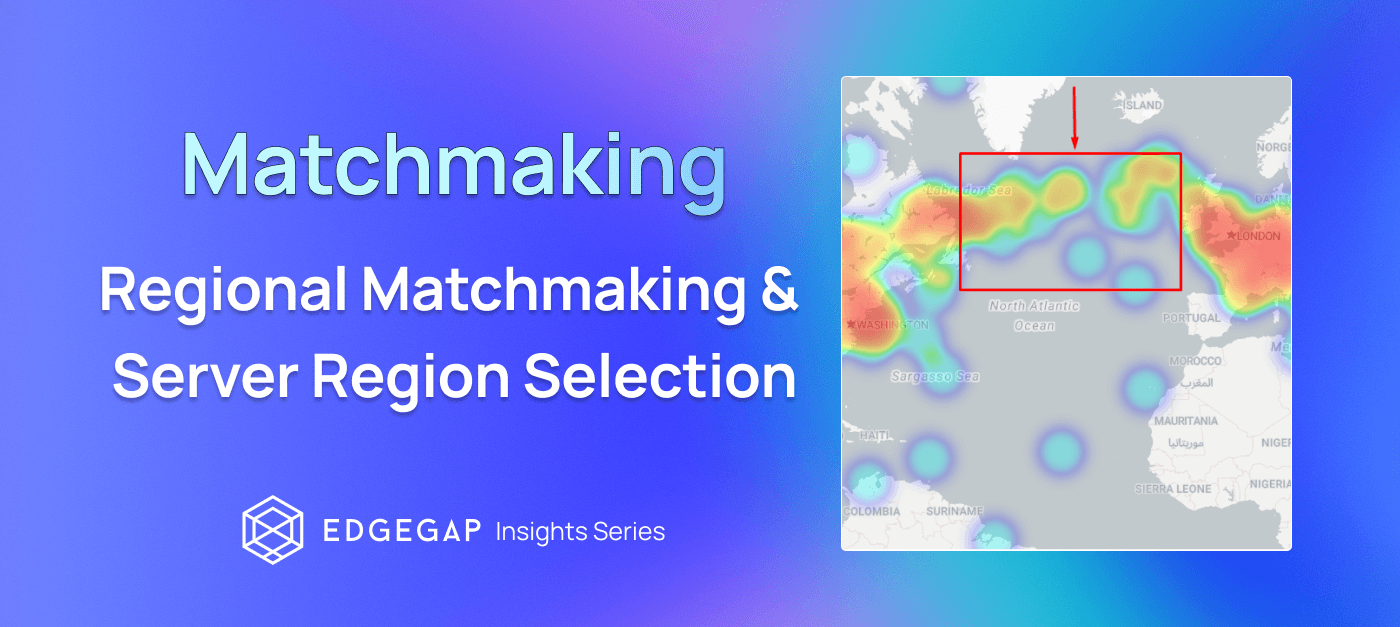
Where a match’s server starts is a separate step. By default, Edgegap’s matchmaker places it with Server Score, from the players’ public IPs or geo coordinates and Edgegap’s own network telemetry, at a balance point with roughly equal network proximity to every player in the match; a game can also send the coordinates of a player’s fastest beacon instead (Edgegap docs). Our regional matchmaking deep dive covers regional matchmaking and the balance point.


A word from our sponsor (ourselves!)
Most lag comes from distance, not from code. Edgegap's Edge Cloud is a distributed network with up to 615+ locations available on demand, so each match runs at the best available location for its players. Independent replays of live studio traffic measured a 58% drop in average round-trip time compared with public cloud.