Matchmaking Queue
A matchmaking queue is the pool of players waiting to be matched for one way to play, such as a game mode or a ranked playlist. Players in different queues typically aren’t matched together, so each queue a game adds splits its player base and can lengthen waits. Many matchmakers soften this with expansion rules that widen who a waiting ticket can match with over time, so narrow groups merge into larger ones and players still find a match when the developer wants them to.
Also called
matchmaking queues, queue, solo queue, role queue
,
What Is a Matchmaking Queue?
When players press “Find match”, they don’t join a match. They join a queue: the pool of players waiting for the same way to play. The matchmaker reads that pool, groups players whose requests fit together, and asks for a server for each match.
In the session lifecycle, the queue sits between the group and the game:
Friends gather in a party or lobby.
The party enters a queue as one request, often called a ticket.
The matchmaker forms matches from the tickets in that queue.
A game server is allocated and the players connect.
A matchmaking queue isn’t strictly first in, first out: the matchmaker can only match tickets that fit together, so a newer ticket can be matched before an older one. And players in different queues aren’t matched together, which is both the point of a queue and its cost.
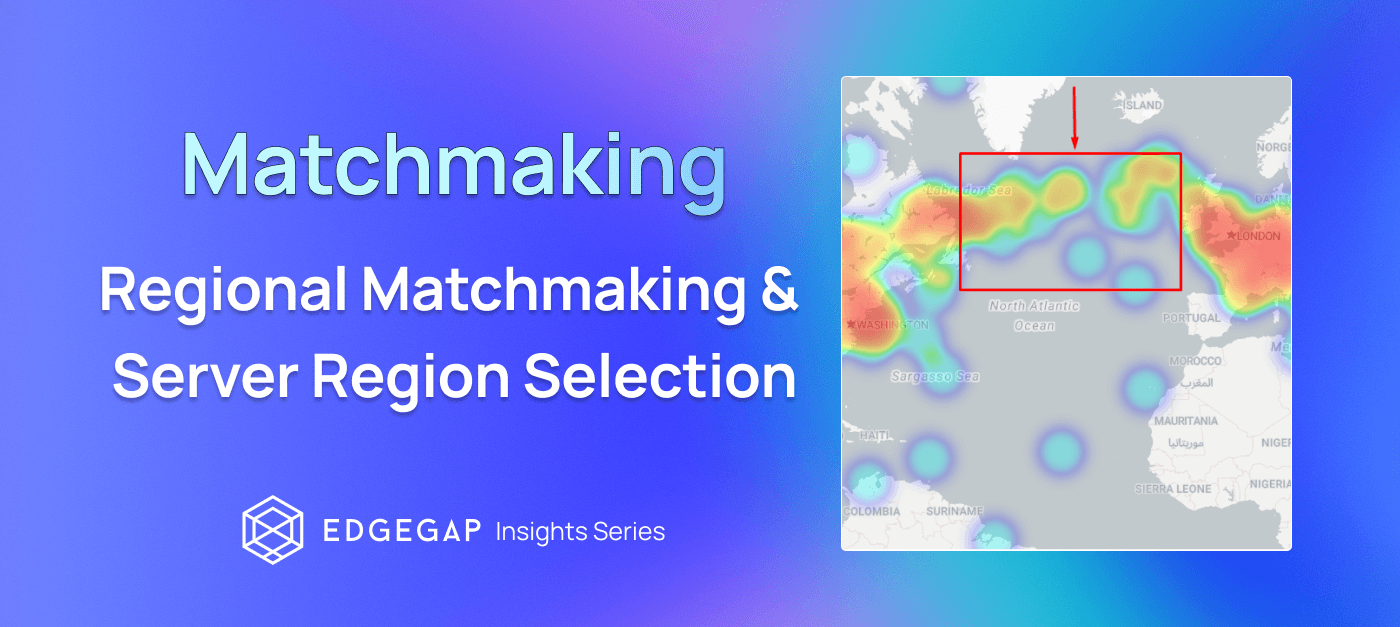
In Practices - Insights from Edgegap's Blog
Article's key insights
Region selection is a player complaint, not a feature request: When players ask to pick their server region, they are reporting a latency problem they cannot see or control. The feature they request is one possible answer, and on a smaller playerbase it trades bad matches for unfilled ones.
Latency-based grouping solves the issue that region locking attempts to mitigate: Regions are administrative boundaries. Latency is measured. Grouping players by measured ping keeps distant players out of the same lobby without partitioning the queue by geography.
Relaxing rules over time is the lever most matchmakers underuse: Activision's published research loosens skill constraints faster than connection constraints as queue time grows. The same graduated approach applies to any pooling rule.
Queue time is negotiable when the tradeoff is visible: Players in several communities volunteer to wait longer for better connection or a more filled match. The waiting is not what frustrates them. Not knowing what it buys them is.
Transparency and agency shorten the feedback loop: A visible ping figure and an opt-in to wait for a closer server turn vague blame into something a player can act on, at the cost of exposing numbers you may not want exposed.
Should You Split the Queue or Relax the Rules?
Every queue you add divides the players searching. One mode with ranked and unranked play, three regions, and separate solo and party options already makes twelve pools instead of one, and each fills more slowly, most of all at quiet hours.
Overwatch shows the cost. Its director wrote that before Role Queue, “the matchmaker just needed to find 12 players of similar skill levels”. With a queue per role, fewer players queued as Tank, and he names “the ratio of players queued in each role” as the main driver of longer queue times (Blizzard).
Split the queue | One queue, relaxing rules | |
|---|---|---|
Use it when | Players must never meet: different modes, ranked vs unranked, incompatible builds | Players could meet, just not ideally: skill, latency, role, party size |
Wait times | Each pool is smaller, so waits grow | Usually shorter, because the pool stays whole |
Match quality | Separation is strict; quality rules can still relax inside each pool | Starts strict and loosens as a ticket waits |
Main risk | Empty queues at quiet hours | Loose matches if the rules relax too far |
The alternative to a split is a rule that starts strict and loosens the longer a ticket waits, often called an expansion. Players get a close match when one exists and an acceptable one when it doesn’t, instead of no match at all. The matchmaker page covers how rule relaxation is set up, and server regions covers the regional version of this choice.
Which Queue Types Do Games Use, and Why?
Most queue types exist to keep matches compatible or fair, and each one splits the pool again:
Mode or playlist: different team sizes or rules that can’t share a match.
Ranked and unranked: results count differently, so players who care about their rank are kept apart from casual matches.
Solo and party: a coordinated group can have an edge over strangers, so some games keep solo players apart from parties, or limit party size in ranked play.
Role queue: players choose a role before searching. When Overwatch launched Role Queue in 2019, players would “earn separate skill ratings (SR) for each role in Competitive Play” and see “estimates for the wait time for each at the role-selection screen” (Blizzard).
Several of these can be rules instead of queues. A party-size rule can match parties against parties of a similar size first, then relax, inside one queue. Player complaints about duo queues or flex queues can come down to this trade between fairness and wait time.
What Should Players See While They Wait, or When a Queue Is Closed?
Waiting feels shorter when players know what is happening:
An estimated wait: per queue, or per role, as Overwatch did at Role Queue’s launch, so players can choose a busier queue.
A clear reason when they can’t queue: maintenance, a patch, an outage, or a restriction on their account, with a time if you have one. A generic error tends to send players to forums and social media to find out.
A clear end: tickets expire, so a player who waits too long gets “no match found” rather than an endless search. The matchmaker page covers ticket expiry.


A word from our sponsor (ourselves!)
Every empty player slot is capacity you pay for and nobody uses. One studio on Edgegap's matchmaker averaged 91% of player slots filled across its sessions in Q2 2025, so fewer servers carried the same players.
Edgegap's Take (just our opinion, take it with a grain of salt!)
Add a Rule Before You Add a Queue
Before splitting a queue, estimate how many players the smaller queue would hold at your quietest hour, in your smallest region. If that isn’t enough to fill a match within your target wait, make the split a rule that relaxes over time instead. On Edgegap’s matchmaker, each profile is a separate queue with its own rules, and the documentation warns that “splitting up your player base in multiple profiles may result in longer queue times for your players” (Edgegap docs).
Relax latency last. Our regional matchmaking deep dive recommends grouping players by measured ping (ping beacons) inside one queue, and cites Activision’s research that skill rules can loosen faster than connection rules. Then place each match’s server near its players, so a looser match still plays well: Edgegap deploys across 615+ locations (platform data, as of 18 September 2026).
Jakub Motyl, Product Director
,